Are the Concepts of Philosophy, Metaphysics, and Civilization Ours?
 halka
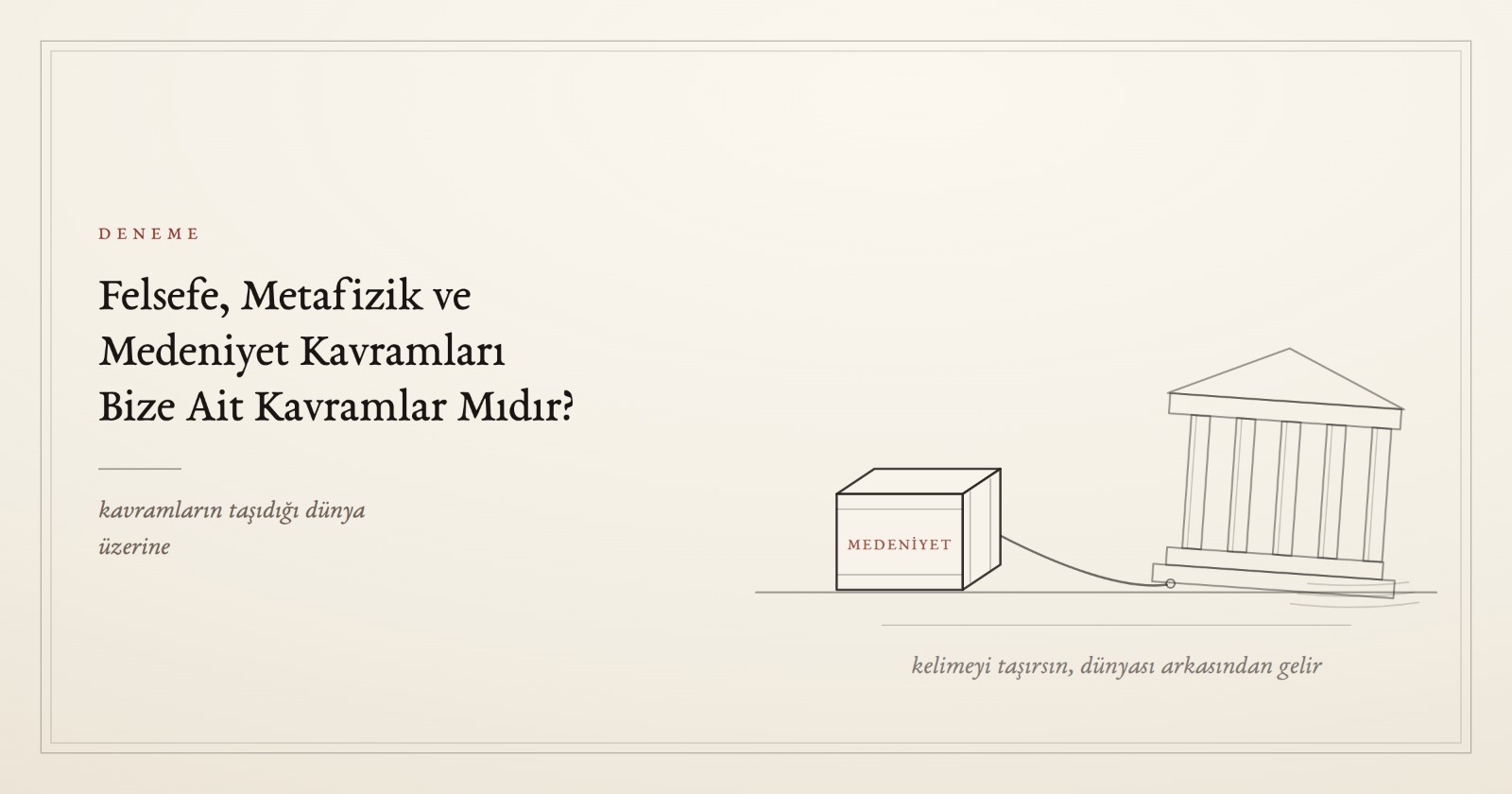
Historically, scholars (ulama) meticulously distinguished between the concepts of theology (kalam) and philosophy, and refrained from using the word “philosophy” for their own scholarly activities. Today, however, many Muslims engaged in knowledge and thought can easily use not only the word philosophy but even the word “metaphysics” for their own thoughts and beliefs. Yet, the word metaphysics is a much more loaded concept compared to the word philosophy. Although the word philosophy is also a loaded concept compared to the word thought, it has lightened its load a bit compared to metaphysics due to having flexible usages that even commoners can use in practical life. Today, we see that even Muslims engaged in Islamic sciences can easily embrace the word metaphysics, and some use it almost synonymously with Islamic belief. For instance, a sentence like “Muslims need to construct a new metaphysics” has now reached a level where it does not grate on the ear in the marketplace of ideas. We might be doing something very right in terms of meaning. Our concern and intention might be very sincere, pure, and correct. But we must not forget that words also have a world, a power, and a sphere of influence of their own. Every individual and every society will surely have their own unique thought. However, how possible is it to completely isolate the words philosophy and metaphysics from the thought of the society in which they first came into existence and from the existential connections this society established with the world? Similarly, how much can we detach ourselves from the worlds these words acquired in subsequent societies and the thoughts, concerns, reading frameworks, and ways of making sense of humanity, life, and death that they have accumulated over the centuries?
Why do we embrace the words philosophy and metaphysics so easily? Even Heidegger, despite being the continuation of that great tradition of thought in our eyes, uses neither the word philosophy nor metaphysics to express his own thought. He develops his own specific concepts to explain his concern. While this is the case, how can we so easily and almost to express Islam use these words that do not originally belong to our tradition?
Al-Sayyid al-Sharif al-Jurjani, in Sharh al-Mawaqif, while harshly criticizing some of al-Taftazani’s thoughts in Sharh al-Maqasid during the discussions on the subject matter of kalam, accuses him of “feeding from the philosophers.” We have transitioned from a context where the word philosophy could be used as an expression of insult to a context where we become happy when we discover the existence of a philosophy in the Muslim experience at some period in history.
Abdurrahman Arslan, regarding the concept of civilization—which is a much more innocent concept than the concept of metaphysics, and we perhaps use this concept ten times a day; it is one of the three or four words with which we define ourselves—says in meaning: “The word civilization is a concept whose wording belongs to us, but its content does not.” According to Arslan, who says that Islam cannot be conceptualized as civilization, the concept of civilization is first and foremost and overly a Western-centric conceptualization. It is a product of an inferiority complex in the face of Western civilization and is a secular concept. It is not difficult at all to feel the secularity of the concept of civilization. Today in Arabic, the expression “civil state” (الدولة المدنية) is used in the sense of a “secular state” (الدولة العلمانية) as the opposite of an understanding of a state based on religion. Similarly, the term “civil law” (medenî hukuk) used in Turkish expresses secular law as the counterpart to sharia. The concept of civilization in the West is translated today in Arabic as “حضارة” (hadara). A century ago, this word could be expressed as “عُمران” (umran).
In summary, whether the content of a concept belongs to us and to which world it connects us is a very vital issue. For concepts are actually zipped beliefs. Carrying them somewhere absolutely means dragging their own contexts and the world they belong to there along with them to some extent.