Is Every Muslim Actually Engaging in Kalam and Fiqh?: On the Necessity of Studying Kalam and Fiqh
 halka
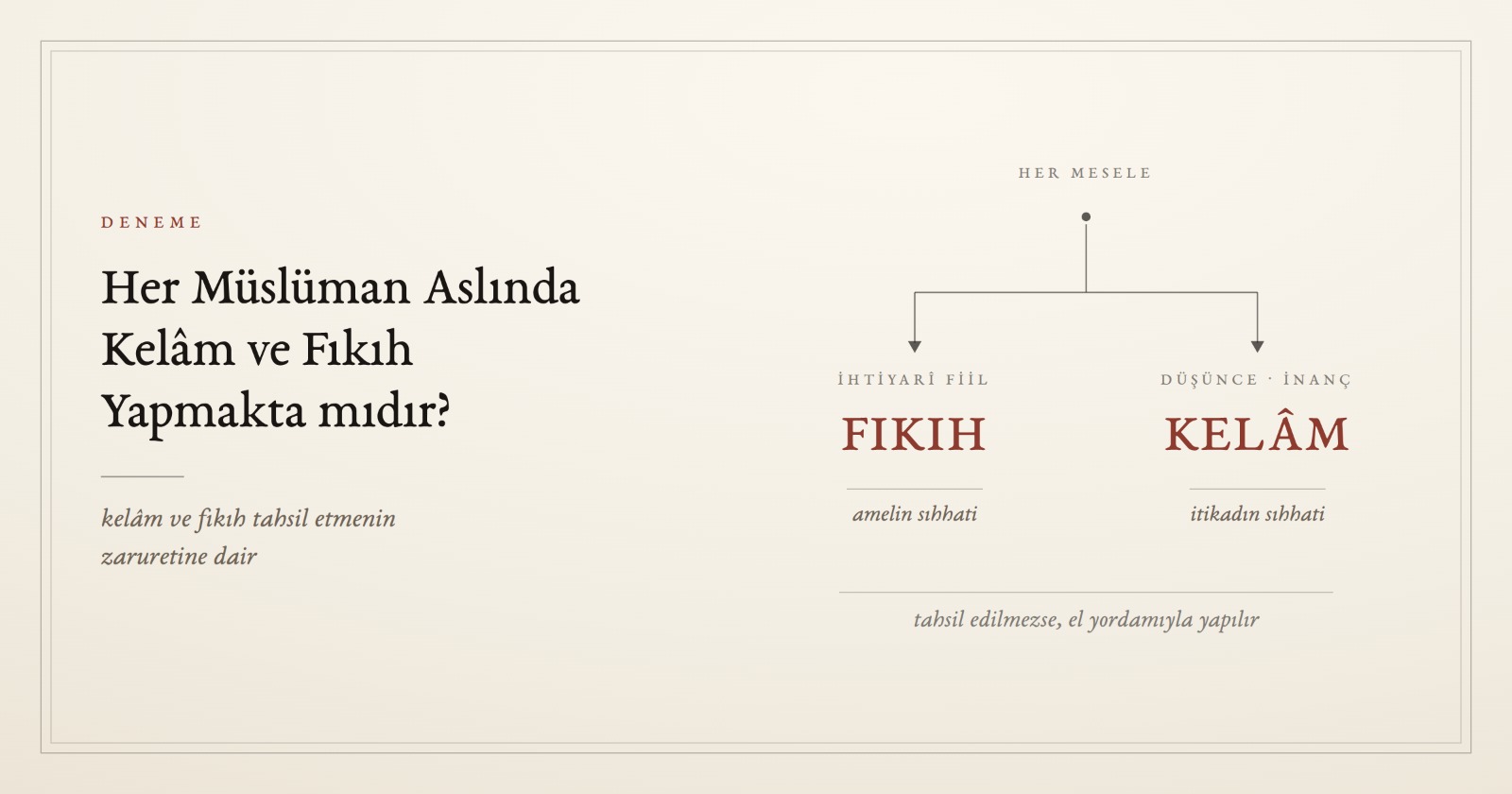
All Muslims pondering over today’s scholarly, intellectual, or practical issues are actually engaging in kalam or fiqh in one way or another. Especially those who deal with knowledge and thought as a profession, or those who carry out a serious intellectual activity regarding the circumstances they face, constitute the strongest examples of this observation. It is not necessary for these people to be directly engaged in the sciences of kalam and fiqh, or even, in a broader sense, in the Islamic sciences. Even if they do not use the terminology, and even if they are not acquainted with the issues, evidences, methods, names, and debates in kalam and fiqh, these people in fact take into consideration whether a thought, an action, a stance, or a preference they make the subject of their thoughts conforms to Islam in some way; they make their judgments by factoring in their knowledge of Islam. For these people are Muslims who read, think, and try to navigate with a certain awareness and consistency. Quite naturally, they will not be able to completely isolate themselves from a part of their world of knowledge and belief. Even those who say that Islam does not have, and should not have, any say in many issues are saying this as a result of a certain understanding and attitude regarding Islam.
Now, if we consider any issue, if this issue concerns a voluntary action, it enters the domain of fiqh; if it concerns a thought, an idea, a belief, knowledge, a worldview, or a philosophy, it enters the domain of kalam in one way or another. Engaging in fiqh within the science of fiqh consists of the effort to scientifically give a ruling on an issue that falls into the domain of fiqh. Engaging in kalam within the science of kalam consists of the effort to scientifically give a ruling on an issue that falls into the domain of kalam. The most fundamental element distinguishing these two efforts from thinking in a secular manner about the issues falling into the said domains is, of course, the taking of Islam into consideration in them. However, what is more important for our topic is that the phenomenon of taking Islam into consideration takes place at the level of the seriousness and discipline of a branch of science. Muslims who think and give rulings on matters falling into the domains of kalam and fiqh without knowing kalam and fiqh (that is, in almost every matter they actually talk about!) are also engaging in kalam and fiqh. However, they do this by groping in the dark, often as if reinventing the wheel, falling into gross errors, with primitive methods, and drowning in incoherence and inconsistencies. Yes, regardless of the soundness and quality of the kalam or fiqh being done, we can say that every thinking and speaking Muslim is actually engaging in kalam and fiqh. But those who do not study these sciences engage in a kalam and fiqh that is extremely erroneous, deficient, and distorted, depending on the situation. In the flowing world of thought and action, everyone somehow possesses certain convictions and holds certain positions. Nature abhors a vacuum. One who does not study kalam and fiqh will not abandon engaging in kalam and fiqh, but will engage in a poor-quality and distorted kalam and fiqh.
This described picture can also be considered to a certain extent for other Islamic sciences, and especially for usul al-fiqh (methodology of Islamic jurisprudence). However, we have considered the sciences of kalam and fiqh here as the sciences among the Islamic sciences whose fruits are sought in and of themselves, and which encompass the world of thought and action. Kalam and fiqh are the only sciences whose fruits are sought in and of themselves. Among the Islamic sciences, they are not sciences that have an aspect of being an “instrument” (ala) and “auxiliary” to other sciences. The soundness of belief and the soundness of action are the ultimate fruits, and kalam undertakes the first, while fiqh undertakes the second.